Blog Moved to http://kosmandu.wordpress.com
Comments are closed and this blog will not be available after a month
Thanks
Pradipta
Sunday, February 03, 2008


Saturday, September 15, 2007
Tiny Aakash Gangas
Oops! I got it wrong and had to re-edit this post. Well, I've decided to write here even though I may not be able to create the pdf ezine anymore (at least for some period of time).
I just read that there exists more dark matter dominated tiny galaxies surrounding our own Milky Way than previously thought. Since these 'invisible' galaxies are difficult to find, the theory that these should exist around big ones was more a mystery until this new find. The find came from astronomers Dr. Marla Geha and Dr. Josh Simon at W. M. Keck Observatory in Hawaii by studying previously discovered dwarf galaxies. They closely observed 814 stars in eight such dwarf galaxies first discovered with the Sloan Digital Sky Survey.
Read about this at http://www.keckobservatory.org/article.php?id=147
My say: "The cold dark matter theory is heading North! ;-) "
I just read that there exists more dark matter dominated tiny galaxies surrounding our own Milky Way than previously thought. Since these 'invisible' galaxies are difficult to find, the theory that these should exist around big ones was more a mystery until this new find. The find came from astronomers Dr. Marla Geha and Dr. Josh Simon at W. M. Keck Observatory in Hawaii by studying previously discovered dwarf galaxies. They closely observed 814 stars in eight such dwarf galaxies first discovered with the Sloan Digital Sky Survey.
Read about this at http://www.keckobservatory.org/article.php?id=147
My say: "The cold dark matter theory is heading North! ;-) "
Friday, June 22, 2007
SEDSIC-2007 and Site Updates
VIT University Chapter of 'Students for Exploration and Development of Space' (SEDS) is planning to hold an SEDS International Conference (SEDSIC' 07) on 22nd and 23rd of September 2007 at the University premises in Vellore, Tamil Nadu, India.
Events during SEDSIC-2007:
Moon Rover Design Competition, Astro-Expo Exhibition, Cosmo Guide (carrer talk), Rocket Design Competition, Ham Radio, Star Party
Kosmandu.com updates
Kosmandu.com has been updated with a new forum, a good news section, sky alerts section and many more, updated almost everyday and new features being added every day...
Login to read this month's article or to post on to our forum.
www.kosmandu.com
Other new sites under kosmandu.com:
New astronomy blog
http://blogs.kosmandu.com/astronomy
Social Service blog
http://blogs.kosmandu.com/helpme/
The Astral Journal fourth edition soon available at www.kosmandu.com
Events during SEDSIC-2007:
Moon Rover Design Competition, Astro-Expo Exhibition, Cosmo Guide (carrer talk), Rocket Design Competition, Ham Radio, Star Party
Kosmandu.com updates
Kosmandu.com has been updated with a new forum, a good news section, sky alerts section and many more, updated almost everyday and new features being added every day...
Login to read this month's article or to post on to our forum.
www.kosmandu.com
Other new sites under kosmandu.com:
New astronomy blog
http://blogs.kosmandu.com/astronomy
Social Service blog
http://blogs.kosmandu.com/helpme/
The Astral Journal fourth edition soon available at www.kosmandu.com
Friday, May 25, 2007
Jestha sky: excerpts from article
Well, I have sent my second article to the magazine Science and Future. Here's an excerpt
...Saturn, Venus and Mercury are getting closer........These three planets will stay close for the rest of the month. On 22nd Jestha, Mercury (0.9) is a bit higher and is still lining up with the other two (...there's a map in the article)... Jupiter is also climbing higher everyday, and is very bright (mag -2.6) for the month....On 23rd, it will be at opposition...
14 JESTHA: Waxing Gibbous Moon close to Spica (0.98, Virgo)
17 JESTHA: Moon near Antares (0.96, Scorpius)
18 JESTHA: Full Moon (rises at 7:28pm)
Morning (before twilight): Antares-Moon within 3 degrees
Evening: Jupiter-Full Moon-Antares triangle
25 JESTHA: Last Quarter
28 JESTHA: Crescent Moon and Mars rise together before 2 am, both in Pisces constellation
1 ASHAD: New Moon
Monday, May 21, 2007
Interests
We are calling student teams from wide range of fields including Physics, Engineering, Electronics, Robotics and Geology to participate in workshops and bring their ideas about any possible student-based research projects on Astronomy and Geophysics. We have not yet fixed dates for all this however.
These include the topics of interest:
1. Radio Astronomy Projects: Cosmic Ray detection (Muni Shakya, Lok Narayan Jha)
2. LASER based Communication (Kathmandu Engineering College)
3. Solar: Development of Magnetometers, etc
4. Exoplanet Search
5. Aerospace/Aviation/Rocketry: Remote Control UAV and scientific payload
Launch rockets/RC aeroplanes with experimental/scientific payloads, payload recovery for data processing/analysis
Experimentation on propellants/rocketry
6. Archaeoastronomy: Trekkings to remote villages to excavate and learn from ruins of ancient chhatedhunga, etc.
7. Atmospheric sciences, environmental sciences, meteorology
8. Preparation for the 2009 Total Solar Eclipse, Path of totality crosses eastern region of our country
These include the topics of interest:
1. Radio Astronomy Projects: Cosmic Ray detection (Muni Shakya, Lok Narayan Jha)
2. LASER based Communication (Kathmandu Engineering College)
3. Solar: Development of Magnetometers, etc
4. Exoplanet Search
5. Aerospace/Aviation/Rocketry: Remote Control UAV and scientific payload
Launch rockets/RC aeroplanes with experimental/scientific payloads, payload recovery for data processing/analysis
Experimentation on propellants/rocketry
6. Archaeoastronomy: Trekkings to remote villages to excavate and learn from ruins of ancient chhatedhunga, etc.
7. Atmospheric sciences, environmental sciences, meteorology
8. Preparation for the 2009 Total Solar Eclipse, Path of totality crosses eastern region of our country
Saturday, April 28, 2007
उदेश्य के लिनु? उडी छुनु चन्द्र एक -लक्ष्मीप्रसाद देवकोटा
Udeshya Ke Linu Udi Chhunu Chandra Ek
-Laxmi Prasad Devkota
It is not that Nepal has never seen talents and geniuses. We do have a history rich of creativity and science since time immemorial though this didn’t develop into something bigger as of now. Today, we lack these talents but have started seeing fresh new ones. When rest of the nation was ‘sleeping’ during 1960s-70s, a man was busy building his own telescope that did the perfect job as did Galileo’s in 1600s. Later this man was to become the first man in the world (and you heard it right) to build the microcomputer. In 1979 a Patan resident and 37 year old Muni Shakya, now 65, of Newar community surprised the world with its first microcomputer that we call PC today. He came with more surprises in later days like introducing first devanagari script on computers, making his own radiation monitor and many other computing breakthroughs during the 80s and 90s.
We have to believe in ultimate satisfaction rather than current day comfort, as Muni Shakya says, to reach a developed Nepal. Today, we have the best Engineering Colleges in the region, emerging successful manpower and better knowledge of resources, but we just lack the initiative and vision. People here do not think ‘it is possible to their better lifestyle with better life style of all’. First you give to the nation and the nation will give to you. That’s the only way of seeing progress to a highly backward society like ours.
Path to Success:
Current active members of Kosmandu Astronomical Society, now also as SEDS Nepal Chapter and some well wishers are now discussing initiatives starting this June. As a member of National IHY 2007 celebration committee, I am proposing some ideas on behalf of Kosmandu (SEDS-Nepal) to the committee. Besides, we will continue other public outreach programs that we initiated long ago.
The following initiatives will be taken during the International Heliophysical Year 2007:
-Laxmi Prasad Devkota
It is not that Nepal has never seen talents and geniuses. We do have a history rich of creativity and science since time immemorial though this didn’t develop into something bigger as of now. Today, we lack these talents but have started seeing fresh new ones. When rest of the nation was ‘sleeping’ during 1960s-70s, a man was busy building his own telescope that did the perfect job as did Galileo’s in 1600s. Later this man was to become the first man in the world (and you heard it right) to build the microcomputer. In 1979 a Patan resident and 37 year old Muni Shakya, now 65, of Newar community surprised the world with its first microcomputer that we call PC today. He came with more surprises in later days like introducing first devanagari script on computers, making his own radiation monitor and many other computing breakthroughs during the 80s and 90s.
We have to believe in ultimate satisfaction rather than current day comfort, as Muni Shakya says, to reach a developed Nepal. Today, we have the best Engineering Colleges in the region, emerging successful manpower and better knowledge of resources, but we just lack the initiative and vision. People here do not think ‘it is possible to their better lifestyle with better life style of all’. First you give to the nation and the nation will give to you. That’s the only way of seeing progress to a highly backward society like ours.
Path to Success:
Current active members of Kosmandu Astronomical Society, now also as SEDS Nepal Chapter and some well wishers are now discussing initiatives starting this June. As a member of National IHY 2007 celebration committee, I am proposing some ideas on behalf of Kosmandu (SEDS-Nepal) to the committee. Besides, we will continue other public outreach programs that we initiated long ago.
The following initiatives will be taken during the International Heliophysical Year 2007:
- Group Ideas and People ready to do something: Gather information on what can be done and what we want to do. Identify potential groups as well as seek funding and organize a national level conference to initiate new works on the field of astronomy and astrophysics.
- Start possible programs with participation of student groups and professionals as well.
- Use extensive programs of public awareness and student participation in projects designed by the working group.
- Continue with the Permission To Dream project and help more schools and students get directly involved in this project.
[Do check my another entry at http://blogs.seds.org/frozensun]
Wednesday, March 28, 2007
SEDS-Nepal and Astral Journal

We are officially SEDS-Nepal already but we don't have plans until the end of June. I have even stopped publishing The Astral Journal for a few months. Until then, everyone must wait patiently and just find what we have in our newsletters in our Yahoo! group.
I have posted some photos of starfields, moon and Venus in the western horizon (above: lights from Kirtipur on the horizon) in our Yahoo groups. (But I am still having problems with posting them! You know we can't trust the internet here.)
In our sky...
In the morning of 14th April, Moon approaches within 2 minutes (angle) of Mars (now in Aquarius constellation) but it doesn’t happen until 6:53 am when the glare of the sun outshines all the dimmer objects like Mars. Not to worry Mars will still be within 1 degree from the Moon before twilight. The red star near the crescent moon is obviously Mars. Don’t miss this opportunity. Lucky are those living in Hong Kong, Japan and most of the eastern coast of Asia who will observe an occultation of Mars by the Moon.
Friday, February 09, 2007
The fourth issue
I have decided to publish the fourth issue by mid-february collectively for feb, march, april and may (i promise to publish it regularly afterwards).
Check our group-site for info on Feb 10 star party:
http://tech.groups.yahoo.com/group/thecosmicgroup/message/520
This month's sky: article from Nepali Times weekly by Kedar P Badu at:
http://www.nepalitimes.com/issue/334/StarGazing/13193
(Make a username for yourself to view the full article at the Nepali Times website)
Check our group-site for info on Feb 10 star party:
http://tech.groups.yahoo.com/group/thecosmicgroup/message/520
This month's sky: article from Nepali Times weekly by Kedar P Badu at:
http://www.nepalitimes.com/issue/334/StarGazing/13193
(Make a username for yourself to view the full article at the Nepali Times website)
Thursday, January 11, 2007
Magh, the month of Capricornus
Maghé Sankranti is the first day of the month of Magh marking the entering of Sun to Makar or the Capricornus constellation. The sun will remain in this constellation for the whole month of Magh. The first day, Maghé Sankranti, is celebrated with a feast of laddus of til and chaku, ghee, chaku and beaten rice. On the day we worship Lord Vishnu- the Preserver of the Universe to thank for the return of warm season. People around the Hind sub-continent take an early morning bath in holy rivers, visit the shrines of Vishnu and read Bhagavad Gita, a book of stupendous philosophy, that contains sacred instructions given by Krishna to Arjuna during the war of Mahabharata.
The actual date for the entering of Sun accepted by modern astronomers is, however, 6th of Magh. The difference is due to different ways of dividing the sky used by modern astronomers and vedic astronomers. Maghé Sankranti actually marked the winter solstice when the calendar was first introduced. Now, due to the precession of equinoxes this occurs on Poush 7.
The actual date for the entering of Sun accepted by modern astronomers is, however, 6th of Magh. The difference is due to different ways of dividing the sky used by modern astronomers and vedic astronomers. Maghé Sankranti actually marked the winter solstice when the calendar was first introduced. Now, due to the precession of equinoxes this occurs on Poush 7.
Thursday, December 21, 2006
Merry Christmas!! and Happy New Year!!
The third issue will come out very soon in a very different look. It will include some out of astronomy topics as Christmas and New Year special.
I'd like to thank Colin Henshaw for his another article related to astrophysics.
The nights are longer these days (with winter solstice a few hours away from now, while I am typing this). Longer nights mean longer time for observation but the cold is at its peak and we have foggy mornings here. Last night, when I woke up to go to the bathroom, I saw a meteor streak past the sky. In fact, I have seen many meteors in the last few days. I think they belong to the Ursids.
About the Geminids, I didn't actually go out to see it because I was very busy with one of my cousin sisters' marriage ceremony and many other wedding parties. In one of the parties, at about 6 in the evening, many of us saw a big fiery dot passing slowy above us. I told people it could be the ISS but I am still not sure because I have not checked any software. What I know for sure is that it was really bright!!! lol ;-) There were just a few stars seen at that time with all the lights in the party.
I hope everybody will have a great time this christmas, and new year...
Merry Christmas!! and Happy New Year!!
I'd like to thank Colin Henshaw for his another article related to astrophysics.
The nights are longer these days (with winter solstice a few hours away from now, while I am typing this). Longer nights mean longer time for observation but the cold is at its peak and we have foggy mornings here. Last night, when I woke up to go to the bathroom, I saw a meteor streak past the sky. In fact, I have seen many meteors in the last few days. I think they belong to the Ursids.
About the Geminids, I didn't actually go out to see it because I was very busy with one of my cousin sisters' marriage ceremony and many other wedding parties. In one of the parties, at about 6 in the evening, many of us saw a big fiery dot passing slowy above us. I told people it could be the ISS but I am still not sure because I have not checked any software. What I know for sure is that it was really bright!!! lol ;-) There were just a few stars seen at that time with all the lights in the party.
I hope everybody will have a great time this christmas, and new year...
Merry Christmas!! and Happy New Year!!
Monday, December 04, 2006
ISSUE II
Issue II of The Astral Journal will be ready for free download by this weekend at www.kosmandu.com/taj.
Text preview from skygazing section:
Like last month the Moon will again occult the Pleiades star cluster (M45). This month this occurs at about 9:30 am Nepali Standard Time on 4th of the month. This means it will not be seen from Nepal. It will be observed from different parts of North America and Europe though it will not be observed from Southern parts of the world.
Mercury rises at 5h08m NST, Mars at 5h41m NST, Jupiter at 6h04m, and Sun at 6h37 on December 1st. Mercury will slowly enter the glare of the sun while Mars will rise earlier making it visible for the rest of the month. Jupiter will rise more than two hours earlier than the sun by the end of December and increase its brightness to magnitude -1.8.
Mercury, Jupiter and Mars will make a very small triangle in the morning of 10th December. Mercury will pass very close to Jupiter (less than one degree) which will be visible from some parts of the pacific (around 20 deg North +165 deg West near Honolulu) right before sunrise. These three planets will make another triangle in the morning of 11th December reaching east of Jupiter.
Venus is the evening star with a very bright magnitude of -3.9 for the month.
Saturn will be two hours earlier by the end of the month from its rise time at 22:42 on the first to 20:42 on the last. It shines at magnitude 0.7 till the end of the month while it nears earth.
Text preview from skygazing section:
Like last month the Moon will again occult the Pleiades star cluster (M45). This month this occurs at about 9:30 am Nepali Standard Time on 4th of the month. This means it will not be seen from Nepal. It will be observed from different parts of North America and Europe though it will not be observed from Southern parts of the world.
Mercury rises at 5h08m NST, Mars at 5h41m NST, Jupiter at 6h04m, and Sun at 6h37 on December 1st. Mercury will slowly enter the glare of the sun while Mars will rise earlier making it visible for the rest of the month. Jupiter will rise more than two hours earlier than the sun by the end of December and increase its brightness to magnitude -1.8.
Mercury, Jupiter and Mars will make a very small triangle in the morning of 10th December. Mercury will pass very close to Jupiter (less than one degree) which will be visible from some parts of the pacific (around 20 deg North +165 deg West near Honolulu) right before sunrise. These three planets will make another triangle in the morning of 11th December reaching east of Jupiter.
Venus is the evening star with a very bright magnitude of -3.9 for the month.
Saturn will be two hours earlier by the end of the month from its rise time at 22:42 on the first to 20:42 on the last. It shines at magnitude 0.7 till the end of the month while it nears earth.
Sunday, November 19, 2006
Discovering with SOHO: STEREO
In October this year we received some meteorite samples from Neatherd High School and Dereham 6th Form College Astronomy Club, Norfolk, UK. The Club also sent us the second edition of 'Meteorites' published by The Natural History Museum of the UK along with some astronomy posters.
This same school has a great website and has recently added a section about Solar Terrestrial Relations Observatory (STEREO) spacecraft. Visit http://astronomy.neatherd.org/SOS/SOHO/SOHOstereo.htm
This text from NASA's official site for STEREO:
We hope to put an article on this in coming issues of The Astral Journal pdf ezine.
This same school has a great website and has recently added a section about Solar Terrestrial Relations Observatory (STEREO) spacecraft. Visit http://astronomy.neatherd.org/SOS/SOHO/SOHOstereo.htm
This text from NASA's official site for STEREO:
STEREO (Solar TErrestrial RElations Observatory) is the third mission in NASA's
Solar Terrestrial Probes program (STP). This two-year mission will employ two nearly identical
space-based observatories - one ahead of Earth in its orbit, the other trailing
behind - to provide the first-ever stereoscopic measurements to study the Sun
and the nature of its coronal mass ejections, or CMEs.
STEREO's scientific
objectives are to:
Understand the causes and mechanisms of coronal mass
ejection (CME) initiation.
Characterize the propagation of CMEs through the
heliosphere.
Discover the mechanisms and sites of energetic particle
acceleration in the low corona and the interplanetary medium.
Improve the
determination of the structure of the ambient solar wind.
We hope to put an article on this in coming issues of The Astral Journal pdf ezine.
Friday, November 17, 2006
New Sunspots
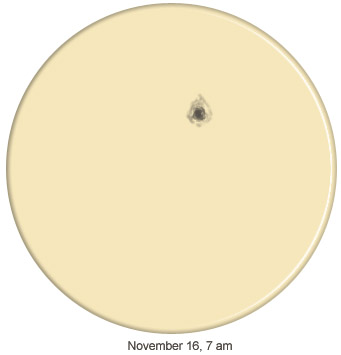
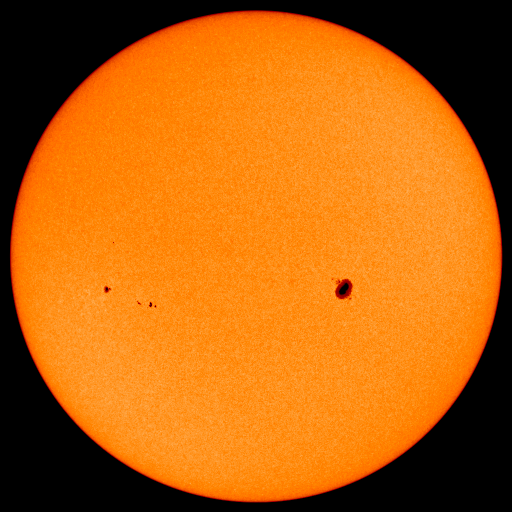
In the morning hour, when the sky is mostly covered with fog, or at sunset we can actually see the sunspot 923 with naked eyes. The first picture is my photoshop art where I have depicted the 923 exactly where I had seen with naked eyes, the viewfinder of my telescope and the telescope itself. I watched it for just a few seconds. If I had watched for a longer time I'd have damaged my eyes. WARNING: Don't ever try watching the sun with/without any instrument without using a proper solar filter.
2nd picture from spaceweather.com
Do these newly appeared sunspots pose any threat for strong solar flares? (My answer is no.)
Thursday, November 16, 2006
Astronomy vs. Astrology
Astrologers say Lagna is more reliable than traditional 'zodiac horoscopes'.
Lagna is taken from start of the day. The lagna at sunrise is the constellation where the sun is supposed to be that time. Two hours later the constellation rising next to the first lagna of the day is taken as the next lagna. The lagna changes every two hours just like this. But if we are taking the reference point at sunrise and the constellation the sun resides in at the sunrise, then we are purely not using the right constellation. It is because no astrologers are updated with the precession of equinoxes. The calculation is again off by one constellation. So lagnas calculated for any time of the day is wrong. So how can the astrologers be so sure that when they are calculating lagnas they are making more accurate predictions?
Lagna is taken from start of the day. The lagna at sunrise is the constellation where the sun is supposed to be that time. Two hours later the constellation rising next to the first lagna of the day is taken as the next lagna. The lagna changes every two hours just like this. But if we are taking the reference point at sunrise and the constellation the sun resides in at the sunrise, then we are purely not using the right constellation. It is because no astrologers are updated with the precession of equinoxes. The calculation is again off by one constellation. So lagnas calculated for any time of the day is wrong. So how can the astrologers be so sure that when they are calculating lagnas they are making more accurate predictions?
Saturday, November 11, 2006
Leonid Meteor Shower 2006
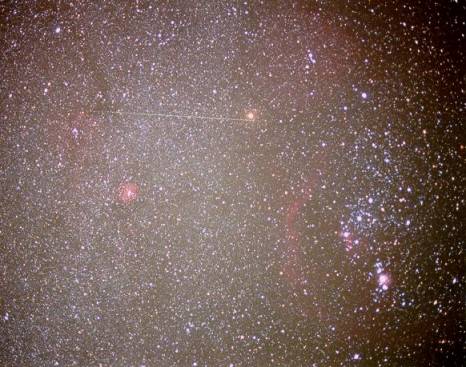
A meteor streaks past the Milky Way in this picture from November 26, 1998 picture of the Day by Jeff Medkeff . While the stars are hundreds to millions of light years away the meteor is just a space rock burning a few kilometers above the earth's surface in the atmosphere.
November is the best time of the year for watching Meteors. Leonid Meteor shower peaks on 19th this month. Evening watchers: Its not the right time to watch but earthgrazers are good to look at. Morning watchers: Its in the mornings that most of the space rocks come into the way of Earth's orbit to enter the atmosphere fast and more in number.
Some researchers state this year's Leonid shower won't be so good. Low meteor rate has been suggested. Keep watching untill 21st from 14th.
Thursday, November 09, 2006
Mercury Transit 2006
Mercury transit of 2006 that occured in the night of 8-9 November was not visible from Nepal. Mercury transited the sun to now become a morning planet. It will rise at 6 on 11th of this month, 5:20 am on 16th, 4:59 on 24th/25th (Greatest elongation on 25th, 20 degress from the sun) and 5:06 on 30th.
You can see visibility map of the transit at http://www.nao.rl.ac.uk/nao/transit/M_2006/. Picture galleries of the transit can be found at the following sites:
SOHO website (NASA) Transit pictures and MPEG videos as seen from SOHO http://sohowww.nascom.nasa.gov/hotshots/2006_11_06/
SpaceWeather (NASA) http://spaceweather.com/eclipses/gallery_08nov06.htm
Animated Transit http://science.nasa.gov/headlines/y2006/20oct_transitofmercury.htm
You can see visibility map of the transit at http://www.nao.rl.ac.uk/nao/transit/M_2006/. Picture galleries of the transit can be found at the following sites:
SOHO website (NASA) Transit pictures and MPEG videos as seen from SOHO http://sohowww.nascom.nasa.gov/hotshots/2006_11_06/
SpaceWeather (NASA) http://spaceweather.com/eclipses/gallery_08nov06.htm
Animated Transit http://science.nasa.gov/headlines/y2006/20oct_transitofmercury.htm
Tuesday, November 07, 2006
Web-resources: LCROSS, Calendar & Pluto
Because the support site for The Astral Journal is not complete yet, I am posting the web-resource materials for some articles in this blog:
LCROSS: WATER ON THE MOON
LAUNCH DATE: OCTOBER 2008
MISSION: To search for water ice deposits on the Moon
The Astral Journal Oct-Nov 06 Page 4
AMES RESEARCH CENTER WEBSITE:
http://www.nasa.gov/centers/ames/home/index.html
LUNAR PROSPECTOR 1988 MOON MISSION: http://discovery.nasa.gov/prospector.html
LCROSS MISSION PICTURES: http://www.nasa.gov/centers/ames/multimedia/images/2006/lunarorbiter.html
CLEMENTINE MISSION: http://science.nasa.gov/headlines/y2005/14apr_moonwater.htm
From JPL's Space Calendar compiled and maintained by Ron Baalke
Click on the links for more info on the events listed
2006
Nov 08 - Mercury Transits the Sun
Nov 17 - Leonids Meteor Shower Peak
Dec 13 - Geminids Meteor Shower Peak
Dec 22 - Winter Solstice, 00:22 UT
Dec 22 - Ursids Meteor Shower Peak
Meteor Showers List:
http://csep10.phys.utk.edu/astr161/lect/meteors/shower_list.html
PLUTO RESEARCH
Go to Mike Brown's website http://www.gps.caltech.edu/~mbrown/planetlila. He discovered the largest dwarf planet (Eris, also called Xena or 2003UB313).
Wikipedia article on new definition of the word 'planet': http://en.wikipedia.org/wiki/2006_definition_of_planet
More simplified article on new definition of 'planets' and Pluto's planetary status will appear in the 2nd issue of The Astral Journal.
Saturday, November 04, 2006
1st issue
October-November 2006 issue (full version) is now available for free download.
The support (and download) website of The Astral Journal is yet to be uploaded.
The Observation of Variable Stars
Types of Variable Stars
Why observe Variable Stars?
How to observe Variable Stars?
Written by Colin Henshaw
Do you still read your HOROSCOPE?
Why are the signs wrong?
Why do planets affect them?
Astronomy came first...
Written by Pradipta Shrestha
Sky Gazing
November 06 article by Kedar P Badu
MessierWatch
MoonMadness
TwilightPlanets
StarGazing
The support (and download) website of The Astral Journal is yet to be uploaded.
The Observation of Variable Stars
Types of Variable Stars
Why observe Variable Stars?
How to observe Variable Stars?
Written by Colin Henshaw
Do you still read your HOROSCOPE?
Why are the signs wrong?
Why do planets affect them?
Astronomy came first...
Written by Pradipta Shrestha
Sky Gazing
November 06 article by Kedar P Badu
MessierWatch
MoonMadness
TwilightPlanets
StarGazing
- 'Da Cosmic Calendar
- LCROSS: Water On The Moon
- The Red Planet in History
- Important Dates
- Astro-Poetry
- Humor: Cosmic Trip Comics Strip
- Space Contest
- Astrophotography
- and more...
The freezine is published through:
Subscribe to:
Posts (Atom)
